
Your solar panels produce the most electricity around midday. Your home often uses the most in the evening, and a heat pump needs power on cold winter nights when panels produce little.
A well-designed system closes that gap. In this guide, we explain how solar panels connect to your home, a battery and the grid, with a simple solar panel connection diagram, and look at how a heat pump fits in.
How a home solar system is connected
Solar panels produce direct current (DC). An inverter converts it to alternating current (AC), the type your home uses, and sends it to your consumer unit. From there it powers your appliances and heat pump, charges a battery, or flows through your smart meter to the grid.
The inverter is the hub: every unit of solar power passes through it before your home can use it. For a deeper look at cabling and isolators, read our solar panel wiring guide.
How solar panels connect to a battery
If you are wondering how to connect solar panels to a battery, there are two ways: DC coupling and AC coupling. The main difference is how many times the electricity is converted between direct current (DC) and alternating current (AC) (Changeworks).
| DC-coupled battery | AC-coupled battery | |
|---|---|---|
| How it connects | Battery links directly to the solar panels, sharing one inverter | Battery sits on the AC side of your home, with its own inverter |
| Conversions | Fewer: power is converted to AC once, when you use it | More: solar power is converted to AC, then back to DC to charge the battery |
| Often suits | New solar and battery systems installed together | Adding a battery to existing solar panels |
Our MCS certified installers survey your existing setup and recommend the right option for your home. If you already have panels, see our solar panel wiring guide for how your current system is wired, or read more about solar panels with battery storage.
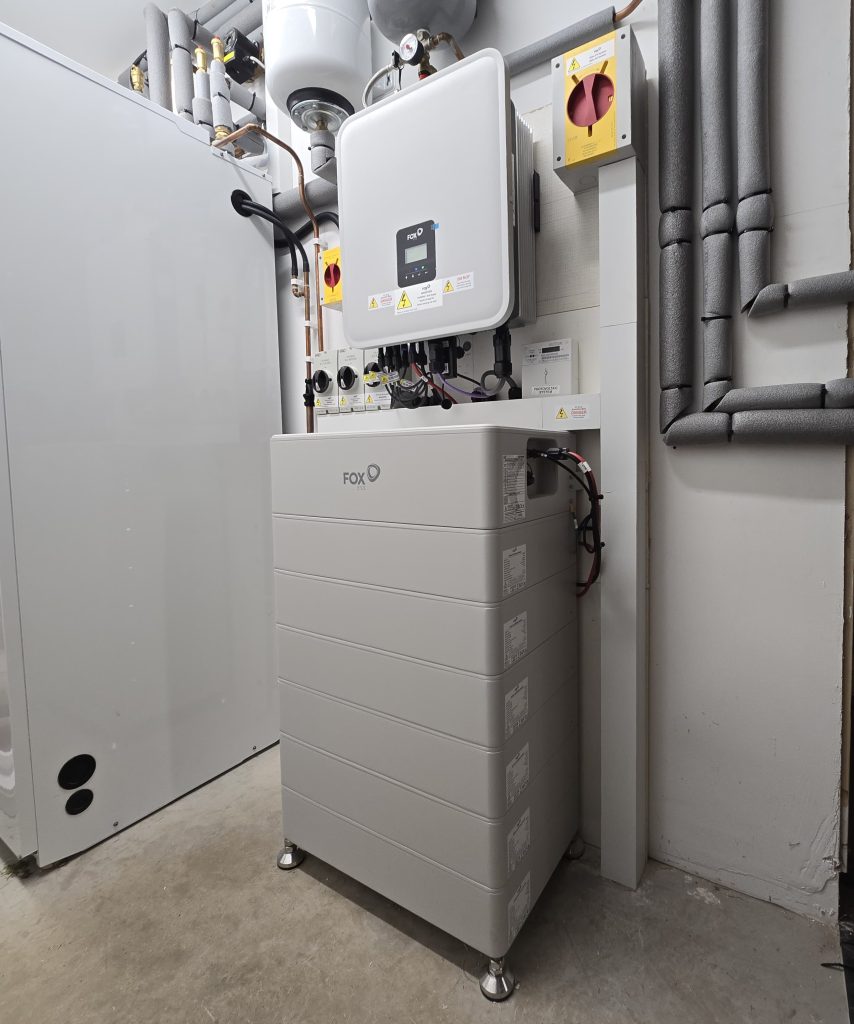
Can you run a heat pump on solar?
Yes, solar panels can power a heat pump when they are generating. You will still use grid electricity at times, because heat pumps work hardest in winter and at night, when panels produce little (Energy Saving Trust). A battery can store daytime surplus to help run your heat pump in the evening.
For more on how solar and heat pumps work across the seasons, read our guide: Will solar panels run a heat pump?
The first step is understanding your heating demand. Take our heat loss quiz to see how a heat pump could fit your home.
Connecting to the grid: why your installer matters
Connecting solar panels, a battery or a heat pump is more than a wiring job. Every installation must be reported to your local Distribution Network Operator (DNO), and your installer is responsible for doing it (MCS).
| Installation | Grid rule | When |
|---|---|---|
| Solar PV up to 16A per phase | G98 notification | Within 28 days of commissioning |
| Solar PV above 16A per phase | G99 application | Permission before connecting |
| Battery storage over 3.68kW | G99 application | Before installation |
| Heat pump (up to 60A maximum demand) | Notification | Within 28 days of installation |
Source: MCS, Notifying DNOs
To be paid for the electricity you export through the Smart Export Guarantee (SEG), your system and installer must be MCS certified, and you need a smart meter that records exports (Energy Saving Trust). That is why grid connection should always be left to a certified installer.

Solar, battery and heat pump installation with Heatforce
At Heatforce, we have been keeping homes warm since 1982. We design and install solar panels, battery storage and heat pumps as one joined-up system, and we handle the DNO notification and MCS paperwork for you.
Our main office is in Pontypridd, and our services are available across the UK, including solar panel installation in Cardiff.
- Adding a battery to existing panels? Get a solar and battery quote
- Planning a heat pump? Take our heat loss quiz
- Wondering about costs? Read our cost of solar panels UK guide
Frequently asked questions
Through DC coupling, where the battery shares the solar inverter, or AC coupling, where the battery has its own inverter on your home's AC supply (Changeworks). An MCS certified installer chooses the right option for your system.
Yes, when the panels are generating. You will still need grid electricity in winter and at night (Energy Saving Trust).
Yes. We check your existing inverter and wiring at survey and recommend the right battery for your system. Your installer must also notify your DNO (MCS).
Your installer must notify your DNO. Larger systems and many solar plus battery systems need permission before connecting (MCS).
Yes, through the Smart Export Guarantee, if your system and installer are MCS certified and you have a smart meter (Energy Saving Trust).


